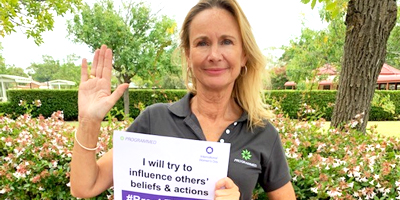
Krista’s Approach to Developing her Career

We caught up with Krista Sambuco from Facility Management who has just completed ten years’ service with Programmed to tell us about her career journey at Programmed and any advice she would like to share on how to develop your career at Programmed.
Tell us what you do at Programmed?
I am part of the Programmed FM Vendor Management Team.
We manage over 1,500 ‘local’ Subcontractors, Suppliers and Consultants with some 17,000 employees across an expanse of over 3,200 kilometres from Kununurra to Esperance, and everywhere in between!
How’d you get into the role?
I started my Programmed journey in early 2011 on the Rottnest Island Contract and was quickly promoted to Purchasing Officer / Project Administrator.
On the island, Programmed maintains building estate, utilities, an aerodrome, roads and grounds, a power plant, water treatment facility, reverse osmosis desalination plant, emergency vehicles and heritage train, as well as soft FM services including housekeeping. Basically – anything you can think of, it is my responsibility to resource it!
The island worker’s dedication to the client, community, and guest experience is extraordinary. Some also give up their time to volunteer with the Fire Brigade – I, myself was the Secretary/ Treasurer with the brigade for many years. The experience cemented my desire to learn about environmental and sustainability impacts as I implemented the first Green Office Program.
Then, in 2017 I was asked to join the WA head office. At the time, I was anxious about transitioning into the corporate world. But my Manager believed in me. Her wisdom and encouragement was inspiring. I grabbed the opportunity with both hands.
Together we developed and established a streamlined, centralised vendor management framework to stop contracts working in operational silos to make us more effective and better placed to accept bigger better challenges. Now, our Team’s advice is sought for new bids, audits, and to improve existing Contracts.
What’s your approach to developing your career?
Here are my top tips for developing your career:
1. Acquire the skills you needThe skills needed throughout your career are fluid and will evolve. For example, I need to be a strong negotiator and these skills can be fine-tuned with practice, self-directed training, and will grow naturally by surrounding yourself with a network of likeminded people. Be resourceful and take the initiative to acquire the skills you need. Organise yourself and plan time for your professional development.
2. Continuous Improvement
To be successful in the facilities management industry, I needed to broaden my understanding of construction and maintenance. I’ve found that you need to possess a willingness to learn, a high degree of problem-solving skills, and a desire to improve your knowledge base continuously. I did this by facilitating ‘Understanding the Basics Workshops’ with a different theme each month.
3. Remember: People are the business
Develop a deep understanding of what the people working for you really do. Engage and build relationships with your stakeholders, who are multi-faceted human beings just like you.
4. Champion Change
I’ve learned to be adaptive to business transformation and develop skills for managing resistance to change along the journey. The trick is to dream big and work back from there. Set smaller goals that are realistic and achievable.
5. Share what you’ve learned
When climbing the corporate ladder, I’ve learned to make sure you elevate others too. This promotes high performing teams. Take every opportunity to support your workmates, and then watch them flourish. You are better placed to step straight into that promotion if you already have a trained and competent person ready to fill in.
6. Get involved
Working together, we achieve big things. Get to know each other and build those networks by getting involved in all that Programmed offers for supporting your community. Showing that you care for others reflects your character.
7. Develop solutionsResearch, align and share your ideas and solutions. Communicate clearly and concisely and align the solution to the problem at hand. Do this in consultation with other stakeholders.
8. Say ‘Yes’!
Some of the best career experiences I’ve had are from doing something that I hadn’t entirely planned before saying ‘Yes’. So leave room to accept the unexpected opportunities that come your way and enjoy the learning process.
What advice would you give people as they look to advance their career at Programmed?
This can be summarised in three (3) points:
1. Take the lead.
A true leader is judged not by their words but by their actions. Develop your own leadership style. You don’t just leave your personality at the door when you arrive at work. Those around you will naturally gravitate towards you if you carry yourself courageously, with integrity and speak up when something isn’t right.
2. Make a go of it.
To flourish, you’ll need to be both trustworthy and trusting. All people deserve an opportunity to make a go of it. Trust them. If they let you down, let them know what went wrong and how it can be improved next time. Allow room for the person to understand how their performance can be improved - they could just rise to the challenge!
3. It’s what you make of it.
I’m a firm believer that in all areas of life, you get out what you put in. Programmed provides you opportunities, if you put in the effort.
There are many ways to advance your career with Programmed. You could try out a different industry, or pursue a complete career change.
If you are ready to take the next step, speak to your manager about your career pathways. It’s what you make of it!
Share you career stories with us!
Many of our people have built a successful career at Programmed. We would like you to share what you have achieved and learned over your career journey at Programmed – your career story will help our people build self-awareness and self-confidence to drive career conversations. If you have a career story to share, click here to tell us more about your career.